




























Views
Downloads

Water Cycle Chart: Essential 4-Step Process | Grade 2

Paste this activity's link or code into your existing LMS (Google Classroom, Canvas, Teams, Schoology, Moodle, etc.).
Students can open and work on the activity right away, with no student login required.
You'll still be able to track student progress and results from your teacher account.
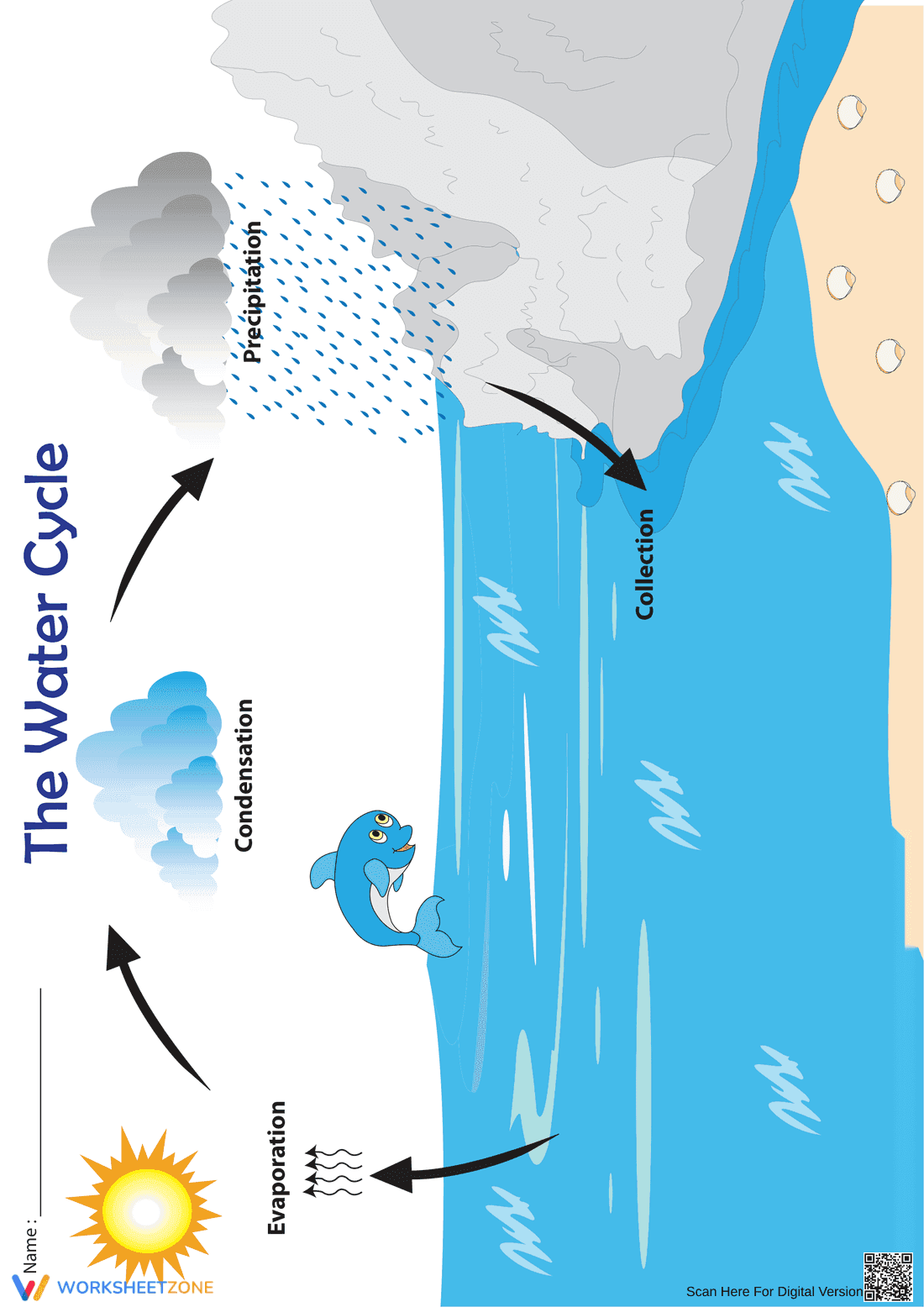
This Grade 2 water cycle worksheet provides a clear visual representation of Earth's most vital process. Students identify and label the four primary stages—evaporation, condensation, precipitation, and collection—to understand how water moves through our environment. It serves as a foundational tool for early Earth science mastery and vocabulary development.
At a Glance
- Grade: 2 · Subject: Science
- Standard:
2-ESS2-3— Identify where water is found on Earth and its various states- Skill Focus: Water cycle stage identification
- Format: 1 page · 4 problems · Answer key included · PDF
- Best For: Introduction to Earth systems and weather
- Time: 15–20 minutes
Inside this resource, you will find a high-quality, single-page diagram featuring vibrant illustrations of the sun, clouds, mountains, and ocean. The worksheet includes four specific labeling tasks corresponding to the major transitions in the hydrologic cycle. A clear, easy-to-read font ensures accessibility for young learners, while the layout provides ample space for student names and responses.
This resource is designed for a zero-prep workflow. First, print the single-page PDF in about 30 seconds. Next, distribute the sheets to your class during your Earth science block. Finally, review the completed diagrams as a whole group using the included answer key to provide immediate feedback. Total teacher preparation time is under 2 minutes, making it an ideal choice for busy mornings or unexpected schedule changes.
This worksheet aligns with `2-ESS2-3`, focusing on the movement and location of water on Earth. By identifying the four stages, students demonstrate an understanding of how water changes state and location throughout the cycle. Both standard codes can be copied directly into lesson plans, IEP goals, or district curriculum mapping tools to ensure compliance with state frameworks.
Use this chart as a formative assessment after a direct instruction lesson on weather. It is also an excellent choice for a science center activity or a quick sub-plan filler. Expect students to complete the labeling and coloring in approximately 15 to 20 minutes. Observe if students can correctly sequence the arrows to determine if they understand the continuous nature of the cycle.
This printable is ideal for Grade 2 students, though it can be used for Grade 1 enrichment or Grade 3 review. It pairs naturally with a classroom anchor chart or a short video about the hydrologic cycle. It supports visual learners through its clear directional arrows and environmental cues, making it accessible for English Language Learners as well.
According to the RAND AIRS 2024 report, visual scaffolding in early science education significantly improves the retention of complex cyclical processes among elementary learners. This worksheet utilizes that research by providing a 4-step framework for the water cycle, specifically targeting the 2-ESS2-3 standard. By isolating evaporation, condensation, precipitation, and collection, the resource reduces cognitive load, allowing students to focus on the vocabulary and the physical transitions of water. Fisher & Frey (2014) emphasize that such graphic organizers are essential for the gradual release of responsibility, moving students from observation to independent identification. This 1-page PDF ensures that Grade 2 students can accurately describe where water is found on Earth and how it moves, providing a measurable data point for science proficiency and curriculum alignment in any standard-based classroom environment. The inclusion of a 4-task structure allows for quick grading and immediate student feedback.


